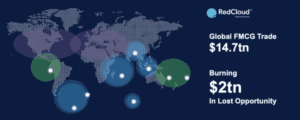
Global trade is broken.
It is inefficient, wasteful, and fundamentally blind. We are trying to run a 21st-century economy on 19th-century rails, and the result is a $2 trillion global inventory gap. That is $2 trillion of lost opportunity – purely because a complex supply chain cannot see where the demand is and match it.
We refuse to accept this.
While others talk about “digital transformation” in air-conditioned boardrooms, real but imperfect trade is happening on the ground in emerging markets. These markets are home to 80% of the world’s population, yet they are treated as an afterthought by legacy systems.
This is a global problem, affecting over 200 countries. So, how do we deploy intelligent infrastructure efficiently across the world? Which countries come first, and why?
The Coverage Strategy: Precision, Not Guesswork
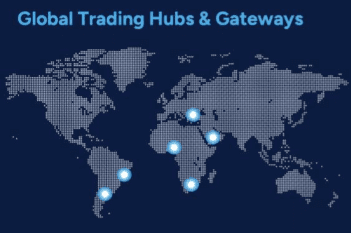
We didn’t throw darts at a map to choose our initial markets. We chose the choke points of global trade.
Our first 6 markets Nigeria, South Africa, Brazil, Argentina, Turkey, and Saudi Arabia – aren’t just countries. They are engines. Together, they represent a $1.72 trillion opportunity right now, growing to $2.46 trillion by 2030.
We deploy here because these are the markets that feed the world.
Take South Africa. It isn’t just a market; it is the source of 70% of US platinum and 100% of US chromium. You cannot build a modern economy without these minerals. By placing a trading hub there, we don’t just capture domestic FMCG trade; we secure a critical bi-directional corridor worth $21 billion in trade with the US alone.

Look at Turkey. It is the only bridge between three continents – Europe, MENA, and Africa. It is a logistics super-connector with a full EU customs union. Our presence there unlocks a $333 billion opportunity that legacy players are too slow to capture.
This is not about “entering a market.” It is about activating a region.
The Hub Effect: Unlocking Adjacent Markets
The true power of intelligent infrastructure is that it doesn’t stop at the border. Intelligent trade spills over.
When we deploy in Nigeria, we aren’t just serving 230 million people in Africa’s fastest-growing FMCG market. We are unlocking the entire West African corridor. Nigeria acts as the gravitational center for adjacent markets like Ghana, Senegal, and Cameroon. We tap into $15 billion of adjacent market opportunity simply by securing the hub.
In the Middle East, Saudi Arabia acts as the gateway. Our infrastructure there opens doors to the UAE, Egypt, and the Gulf states. We turn a national operation into a regional dominance strategy.
This is how you fix global supply chains. You don’t fix every mile of road; you fix the hubs, and the corridors light up.
Bi-Directional Trade: Ending the Extraction Model
For too long, trade with emerging markets has been a one-way street: extraction. Foreign powers built roads to take resources out.
We are building Stargates to facilitate trade both ways.
In Brazil, the recently signed EU-Mercosur deal creates a free trade zone of 780 million people. Our infrastructure there is ready to engage a share of the projected $55 billion in EU bi-directional trade next year, doubling to $120 billion by 2030.
In Nigeria chocolate exports to the US are up 885% year-over-year. That is real economic power. But without intelligent infrastructure to see, track, and optimize that flow, it is just raw product movement. With RedCloud, trade in consumer goods has the potential to become intelligent trade.
Future-Proofing: Following the Population Explosion
We are impatient because the world is changing faster than the old guard can comprehend.
The population is shifting. Consumption is shifting. And we are moving to meet it.
Our next phase – the 10 Expansion hubs – targets FMCG and additional categories across the giants of the next decade: India, Mexico, Indonesia, Vietnam.
Why? Because demographics are destiny
India alone represents a $665 billion opportunity next year, growing to over $1 trillion by 2030. Mexico is benefiting from the massive shift in US nearshoring, creating a $1.09 trillion trade environment.
By 2030, our 16 hubs will cover a combined opportunity of $6.46 trillion.
This is not speculation. This is math.
The Choice is Simple
You can keep relying on blind supply chains and wonder why you are losing market share. Or you can look at the data.
The Belt and Road initiative spent $1 trillion on concrete to extract value. We are deploying capital-light, intelligent infrastructure to create value.
We are live in markets growing at 9% CAGR while the West stagnates. We are capturing the data that runs the real economy.
$1.7 trillion today. $6.5 trillion by 2030.
This is not just trade. This is the new operating system for the global economy.